
 By Admin

Travel planning is evolving in line with tourists‘ desire to experience the trip to a certain destination, rather than just the destination itself. People aren’t just selecting one city and hiring a car to get there and then following a set schedule; they’re creating road trips, or railway trips, or coastal trips, or hiking trips, or multi-stop trips, around the beautiful roads.
This is part of a general trend towards change in travel behavior. People are becoming more flexible, want more memorable experiences, want more discoveries to make locally, and want to experience something at a place they don’t expect. Transportation doesn’t have to be considered a time between attractions but rather an important attraction in the experience.
The Journey Is Becoming Part of the Main Travel Experience
People usually have a place in mind when they travel and plan from there. When travelers choose a destination, they will plan their travel itinerary, including airfares, lodging, meals, and activities, all around that destination.
The opposite of route-based planning is route-based planning. Each location is a stepping stone to the journey and is not its main focus. The method provides greater opportunities for tourists to enjoy the scenery, small towns, regional food, local communities, and places that are not commonly found on tourists’ itineraries.
Scenic Routes Create More Flexible Adventures
A route gives travelers freedom of choice of travel speed. They can go back and stay for more time in a small town, or if the weather isn’t right, they can turn back or find an extra event on the way for the love of God.
This is one of the benefits that is appealing for trips by car and train. Instead of just picking places to visit because of their popularity, travelers will have the option of taking a variety of routes that have a mountain, coastal, forest, historic town, or cultural theme.
Small Stops Can Become Major Memories
Less-known places gain more importance when they are a part of a route-based travel. A roadside market or shop, village café, viewpoint, local festival, or historic station can be one of the most memorable aspects of a trip.
Experiences gained along the way can be more personal, as they aren’t pre-picked from a list of “the big sights. Experiences gained along the way can be more personal, as they aren’t pre-picked from a list of “the big sights.”
How are routes changing, and how is travel planning being affected?
The route-based travel mode is on the rise, as it aligns with a number of traveler priorities that are changing. Rather than visiting as many famous attractions as possible, the travellers can plan activities on their own interests, exploration, and motion.
- There are several locations for travelers to visit in one continuous trip.
- Scenic rides are added into the overall vacation experience.
- With flexible routes, you can explore opportunities as they come when traveling.
- Local areas are also included along with popular tourist towns.
- Vacationers are able to make trips around favorite pastimes.
Technology Makes Route-Based Travel Easier to Build
With the new technology of travel, complicated multi-stop travel can be much easier to organize. Traveled mapping websites, navigation apps, travel forums, booking sites, and digital travel planning tools enable travelers to link different places without building too many travel-planning schedules.
AI is also making a mark on travel planning by assisting consumers to find routes of interest. A dedicated architecture enthusiast can make connections between historic cities, and a foodie can design a route around some of the local specialties.
Travelers Can Search for Experiences Instead of Places
Search behavior also is evolving towards an experience-centric approach. But instead of looking for something to do in Paris or any big city, there are plenty of possibilities of searching for a scenic train ride or a tour on the coastline, mountain roads, a food trail, or a tour of historical roads.
This alters the way that travel inspiration is located. The trip can be a trip to just hang out on the route.
Flexible Itineraries Take the Stress Out of Time Management.
An “itinerary” by its very nature will have a destination. And a destination-focused itinerary can lead to too many activities in a short time. A slower pace can be achieved by using a route-based approach to plan and have a couple of stops in one route.
This doesn’t necessarily equate to further travels. It involves putting more emphasis on the trip itself, rather than on how much it entails in terms of attractions.
Travel Companies Should Take a Step Beyond Destinations.
This is a change that also provides opportunities for travel companies. Hotels, tour operators, transportation services, restaurants, and local attractions can be a valuable component to a trip.
The hotel may be interesting to visitors because it is on a desirable route instead of being in a popular tourist area. Likewise, restaurants and attractions can advertise where they are as a significant “place” in between the bigger places.
Route Planning May Change the Nature of a Vacation.
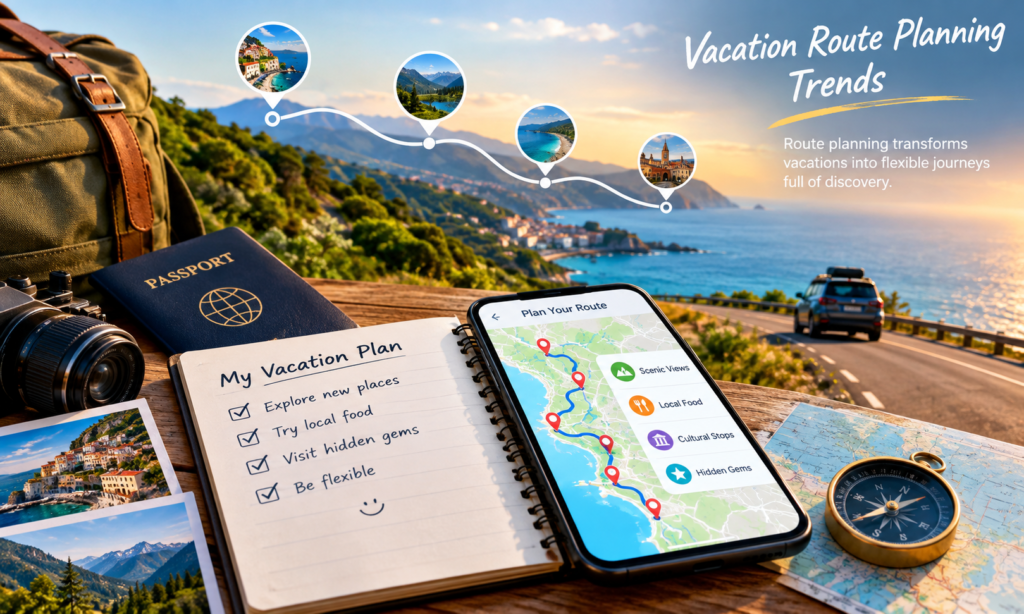
Routes are becoming an increasingly important part of the travel experience, as it reflects a shift towards a more experiential form of travel. It’s not always a successful trip if you are able to reach the most memorable or get the biggest trip.
Travelers, however, are probably more likely to assess their experiences in terms of the quality of their travel, the sites they find along the way to their destinations, and the flexibility to modify plans as they go.
Conclusion
The shift from destination-first thinking to journey-first thinking is taking place in travel planning. Routes are a great way to connect a number of places in an effective trip, to discover unexpected places and experiences, and to be flexible and take the scenic route.
With the ease of multi-stop planning, the journey can be the focus of the trip. It provides both travellers and tourism operators with a new challenge to consider holidays as more than just locations but a journey that takes place from one place to another.
FAQs
1. What does route-based travel mean?
Route-based travel is travel that is arranged round the travel between various places instead of to a single destination. The trip itself, the scenery, the stops, and the experiences are important aspects of the trip.
2. What is motivating travelers to look into route-based traveling?
People are more and more looking for flexibility, experiences in their local area, scenic trips, and novel destinations. These can be offered on a route-based trip without the pressure of the need to stick to a set route.
3. How many routes can be planned by travelers?
Visitors can do coastal driving and scenic train trips, mountain driving, food trips, hiking, and historic and cultural driving trips. It will come down to what you’re interested in and how long you can travel.
4. Is it possible to plan travel based on routes with technology?
Yes. Travelers can link up various hops and make adjustments to their travel plans throughout the trip with digital maps, navigation, travel apps, bookings, and itinerary applications.